Local SEO for Multi-Location Businesses: The Ultimate Scalable Strategy
The moment your business expands beyond a single address, the rules change. You’re no longer optimizing a store – you’re building a network. And the goal of that network is precise: dominate the Google Map Pack for every single location you operate. That’s what local SEO for multi-location businesses is really about – not just visibility, but market ownership, location by location.
Here’s how the best-performing multi-location brands do it.

1. Technical Foundation
This is where most multi-location SEO strategies either win or lose before they even begin. The question is simple: do you put each location on its own subdomain (chicago.yourbrand.com) or in a subfolder (yourbrand.com/chicago)?
The answer, backed by consistent data and confirmed by Google’s own John Mueller, is subfolders – every time. Here’s why: subfolders inherit the domain authority of your root site. Every link, every trust signal, every piece of SEO equity your main domain has earned flows directly into each location page. Subdomains are treated as separate sites – they start from scratch.
Beyond structure, your XML sitemap strategy matters enormously at scale. The right approach:
- Create a master sitemap index at the root domain
- Nest individual location-specific sitemaps beneath it
- Submit the master index to Google Search Console – it crawls every branch from there
2. The Anatomy of a High-Converting Local Landing Page
Every location page needs to earn its place. That means genuinely localized content, not just swapped city names.
The essential elements of a location page that actually ranks:
- Localized Schema.org markup – structured data that tells Google exactly who you are, where you are, and what you do at that specific address
- Consistent NAP (Name, Address, Phone) – must match exactly across your site, GBP, and every directory listing
- Localized meta title and description – “Best [Service] in [City]” still works when it’s accurate and specific
- Location-specific social proof – photos of the actual location, reviews from local customers, staff bios tied to that branch
3. Master Google Business Profile at Scale
Bulk Verification is the starting point. If you have 10 or more locations, apply for Google’s bulk verification process through your GBP dashboard. This avoids the slow, error-prone process of verifying each listing individually and reduces the risk of triggering spam filters.
Once verified, keep every listing active with regular GBP Posts and localized offers. Google’s local algorithm favors active profiles. A listing that hasn’t been updated in three months signals neglect and ranks accordingly.
The most common reasons multi-location accounts get flagged:
- Using a single tracking phone number across all locations (each location must have its own direct number)
- Keyword-stuffing the business name field
- Mismatched NAP between GBP and the website
- Listing a virtual office or shared co-working space as a primary address
Stay clean. Stay consistent. GBP suspensions at scale are difficult, slow, and expensive to resolve.
4. Scaling Local Authority: Citations and Backlinks
Your core citation targets for every location:
- Google Business Profile, Yelp, Apple Maps, Bing Places
- Industry-specific directories relevant to your category
- Local Chamber of Commerce listings
Beyond citations, the local link playbook is where serious authority is built. For each location, pursue links from:
- Local news outlets covering the community
- Charities or non-profits your branch sponsors
- Local events your team participates in
- University or government domains in that city
These links carry hyper-local relevance signals that no national directory can replicate. One link from a city’s community newspaper is worth more than fifty generic directory listings.
5. Reputation Management
Review volume and recency are direct ranking factors in Google’s local algorithm. This isn’t opinion – it’s documented in Google’s own local search documentation. The businesses that show up in the Map Pack consistently are the ones that ask for reviews consistently.
The most effective system is CRM-triggered automation: when a transaction closes or a service is completed, an automated message goes out within the hour asking for a review. The closer to the experience, the higher the response rate.
Equally important and consistently overlooked is responding to every review. Everyone. According to research by Dr. Stephan Ludwig (Journal of Marketing, 2022), businesses that respond to negative reviews see measurable recovery in consumer trust ratings. Google also treats response activity as an engagement signal in local rankings.
The Bottom Line
Local SEO for multi-location businesses done right turns every branch into its own search engine asset. Done wrong, your locations compete against each other, dilute your domain authority, and hand market share to leaner, better-optimized competitors.
We’ve built and managed local SEO systems for multi-location brands across industries – and we know exactly where the gaps are.
Ready to audit your current multi-location strategy? Let’s find out what’s working, what’s leaking, and what’s costing you Map Pack positions in markets you should already own.
Get in touch with the Graphicwise team today and let’s build a local SEO strategy that scales with your growth – not against it.
See more: 6 Steps to Add Your Business to Apple Maps and Boost Local Visibility
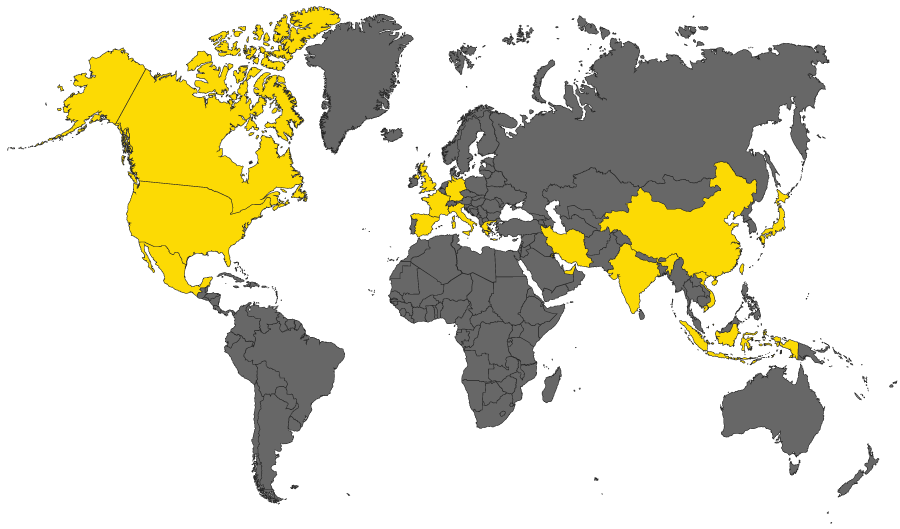
Serving clients across the globe.