5 Common Marketing Mistakes Made by SMEs (And How to Fix Them)
The common marketing mistakes made by SMEs we’re about to unpack aren’t about effort – you’re already working hard. They’re about strategy. Or more accurately, the lack of it.
But here’s the good news: these mistakes are fixable. And once you fix them, everything changes. Your campaigns start converting. Your pipeline becomes predictable. Your growth stops feeling like a guessing game.

Not Defining a Clear Target Audience and Value Proposition
Why Trying to Market to Everyone Always Fails
This is the first and most damaging of the common marketing mistakes made by SMEs: believing that casting a wider net brings more customers.
When your messaging tries to appeal to everyone, it connects with no one. You become generic, forgettable, and interchangeable with every competitor in your space.
And here’s the brutal truth: SMEs don’t have enterprise budgets. You can’t afford to waste impressions on people who will never buy. Every dollar needs precision.
How SMEs Should Define Their Ideal Customer Profile (ICP)
Your ICP should include:
- Demographics: Age, location, income, business size, industry
- Psychographics: Goals, pain points, values, buying triggers
- Behavioral factors: Where they search, how they buy, decision timelines
B2B vs B2C differences matter:
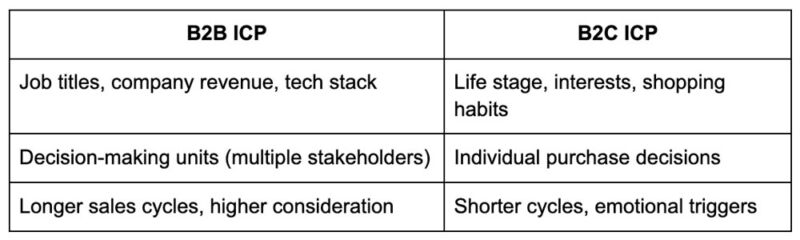
Once you know your ICP inside and out, your marketing gets sharper. Your messaging hits harder. Your budget stretches further.
How to Craft a Strong SME Value Proposition
Use the Problem-Solution-Outcome framework:
- Problem: What specific pain point do you solve?
- Solution: What’s your unique approach to solving it?
- Outcome: What measurable result does the customer get?
Then add differentiation: what makes your solution different from competitors?
Example: “We help growing e-commerce brands reduce cart abandonment by 40% through behavioral email automation – without needing a full-time marketing team.”
That’s specific. That’s memorable. That’s a value proposition.
Operating Without a Structured Marketing Strategy
Why Random Tactics Don’t Create Predictable Growth
This is where we see SMEs burn through budgets fastest: campaign hopping.
One month it’s Instagram ads. Next month it’s LinkedIn. Then someone mentions TikTok, so you try that. Nothing sticks. Nothing compounds.
Without a structured strategy, every tactic is a fresh start. You never build momentum because you’re constantly switching channels before you understand what works.
How SMEs Break the Customer Journey
Here’s what happens when strategy is missing:
- Awareness without conversion: You drive traffic but have no way to capture leads
- Leads without nurturing: Contact forms fill up, but no follow-up system exists
- Sales without retention: You acquire customers once and never engage them again
Each stage needs intention. Each stage needs infrastructure.
What a Simple SME Marketing Plan Should Include
You don’t need a 50-page document. You need a 90-day roadmap that includes:
Core components:
- Business goals: Revenue targets, customer acquisition numbers
- Funnel stages: Awareness → Consideration → Conversion → Retention
- Channel roles: What each platform is responsible for
- Budget allocation: Where money goes and why
- 90-day milestones: What gets done when
A simple plan executed consistently beats a perfect plan that sits in a drawer.
Channel Prioritization for Small Businesses
Not all channels are created equal. And trying to be everywhere is one of the most common marketing mistakes made by SMEs.
Choose wisely:
- Core channel: Where your ICP spends time and has high intent (e.g., Google for local services, LinkedIn for B2B)
- Support channels: Secondary touchpoints that reinforce your message (email, social proof, retargeting)
Match channels to buying behavior. If your customers search for solutions on Google, SEO and paid search should be your foundation – not Instagram.
See more: Level Up Your Digital Marketing: The Best (and Free!) AI Tools You Need Right Now
Weak Online Presence and Inconsistent Branding
Why Your Website Is Still Your Primary Sales Asset
Social media changes. Algorithms shift. Ad costs rise.
But your website? It’s the one asset you fully control. And for most prospects, it’s their first real impression of your business.
Your website must deliver:
- First-impression trust: Professional design, clear messaging, social proof
- Conversion infrastructure: Lead magnets, CTAs, optimized forms
Common SME Branding Inconsistencies That Kill Trust
We see this constantly:
- Logo variations across platforms
- Different brand voices on website vs social media
- Mismatched color schemes and messaging
These inconsistencies create cognitive friction. Prospects subconsciously wonder: “Is this the same company?”
And when trust is fragile, that friction costs conversions.
How Inconsistent Branding Reduces Conversion Rates
A study published in Signature by Lucidpress found that consistent branding increases revenue by up to 23%. Conversely, inconsistency confuses prospects and weakens recall.
The psychology is simple:
- Consistency signals reliability
- Inconsistency signals disorganization
- People buy from brands they trust
How to Build a Consistent Brand Across All Channels
Start with these essentials:
- Brand positioning: Who you are, who you serve, what makes you different
- Messaging hierarchy: Core message, supporting pillars, proof points
- Style guide basics: Logo usage, color palette, typography, tone of voice
Then apply this consistently across your website, social media, email, and offline materials.
Every touchpoint should feel like it comes from the same company.
Ignoring Data, KPIs, and Conversion Optimization
Why “Hope Marketing” Destroys SME Budgets
Hope isn’t a strategy. Yet it’s how most SMEs operate.
They run campaigns based on gut feeling, anecdotal success stories, or what worked for a competitor. They don’t track metrics. They don’t analyze results. They just hope something works.
The problem with guesswork:
- You can’t identify what’s working
- You can’t scale winners
- You repeat losing tactics because you don’t know they’re losing
Core Marketing Metrics Every SME Must Track
Stop measuring vanity metrics like likes and followers. Start tracking metrics that matter:
Essential KPIs:
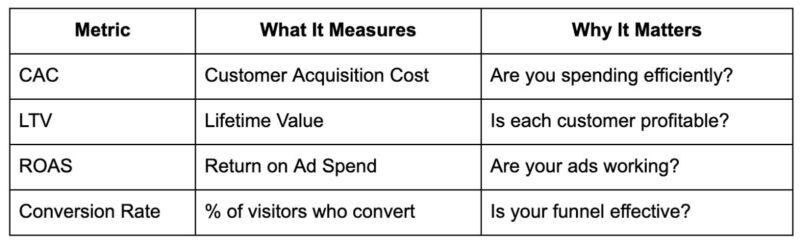
Track the funnel: Traffic → Leads → Customers. If traffic is high but leads are low, your messaging is off. If leads are high but sales are low, your nurturing needs work.
How Data Improves Campaign Performance Over Time
Data doesn’t just tell you what happened – it tells you what to do next.
Use it for:
- A/B testing: Headlines, images, CTAs, landing pages
- Budget reallocation: Move money from underperformers to winners
- Audience refinement: Double down on segments that convert
Small improvements compound. A 10% increase in conversion rate can double your ROI over time.
Conversion Optimization: The Fastest Way to Increase ROI Without More Ad Spend
You don’t always need more traffic. Sometimes you just need to convert better.
Quick wins:
- Landing page structure: Clear headline, compelling offer, single CTA
- Lead magnets: Give value upfront (guides, templates, audits)
- CTAs: Make them specific and action-oriented (“Get Your Free Audit” beats “Learn More”)
Optimizing conversion is the highest-leverage activity in marketing. It multiplies everything else you do.
Relying on One Channel and Neglecting Local & Owned Media
The Risk of Platform Dependency for SMEs
What happens when Facebook changes its algorithm? Or Google increases ad costs by 40%?
If you’re dependent on one channel, you’re vulnerable. And in 2025, that vulnerability is costly.
The dangers:
- Algorithm volatility: Organic reach can disappear overnight
- Rising ad costs: Competition drives up CPCs and CPMs
- Platform risk: Accounts get banned, policies change
Diversification isn’t optional – it’s survival.
Why Local SEO Is a Core Growth Channel for SMEs
For local and regional businesses, local SEO is one of the highest-ROI channels available.
Why it works:
- High-intent searches: People searching “near me” are ready to buy
- Google Business Profile dominance: 76% of local searches result in a visit within 24 hours (source: Google)
- Lower competition: Most SMEs ignore local SEO, leaving opportunity on the table
Optimize your Google Business Profile. Get reviews. Build local citations. Show up when people search.
The Strategic Value of Owned Channels
Rented platforms (social media, paid ads) have their place. But owned channels give you control.
Build these assets:
- Website authority: SEO-optimized content that drives organic traffic
- Email list ownership: Direct access to your audience, no algorithm interference
- CRM data leverage: Customer insights that improve targeting and retention
Your email list is your safety net. When ad costs spike or platforms fail, you still have direct access to your audience.
Final Thoughts
Marketing doesn’t have to feel like a gamble.
When you avoid these common marketing mistakes made by SMEs, everything shifts. Your campaigns convert. Your budget works harder. Your growth becomes predictable instead of chaotic.
The difference between struggling SMEs and thriving ones isn’t talent or luck – it’s strategy. It’s knowing your audience, building a plan, staying consistent, tracking data, and owning your channels.
At Graphicwise, we specialize in helping small to medium-sized businesses build marketing systems that actually work. We’re not just another agency making promises – we’re strategic partners who understand the unique challenges SMEs face: Limited budgets, Stretched teams, The pressure to show ROI fast.
Ready to stop making the same marketing mistakes and start seeing real results? Let’s talk. And let’s build a marketing foundation that drives sustainable growth for your business.
Serving clients across the globe.