What Is AEO? A Complete Beginner’s Guide to Answer Engine Optimization in 2026
The way people search is changing. Not dramatically in appearance, but fundamentally in how search engines work behind the scenes.
For years, SEO was about getting websites to rank on Google’s search results page. You optimized keywords, built backlinks, and tracked position changes. That playbook worked because it answered a simple question: How do I get my site to position #1?
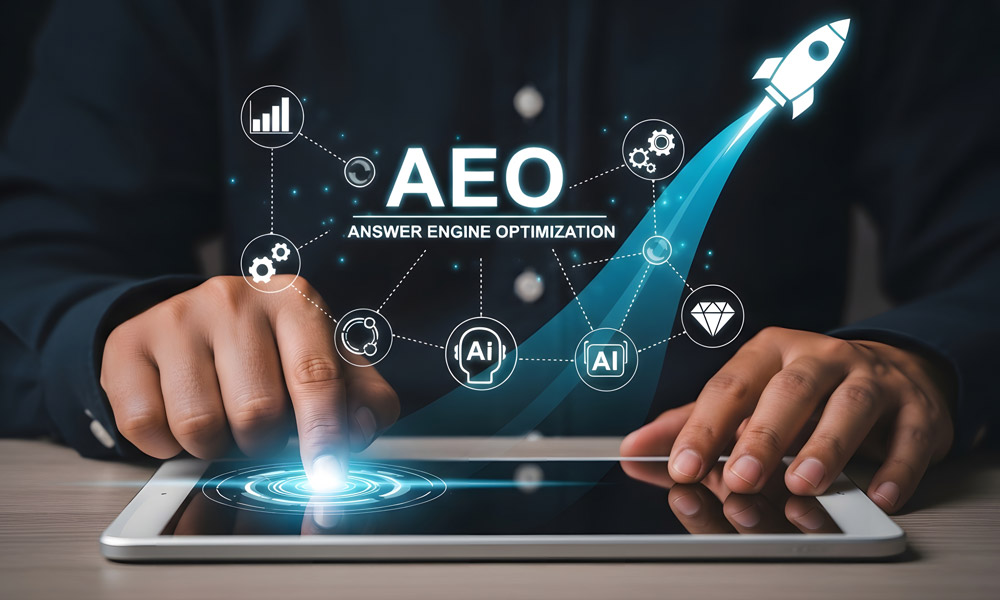
Answer Engine Optimization – or AEO – asks a different question: How do I make sure my content actually answers what people are looking for, regardless of where the AI decides to display it?
This shift matters. And if you work in marketing, own a business, or manage SEO, understanding AEO isn’t optional anymore.
What Is AEO? The Simple Definition
Answer Engine Optimization (AEO) is the practice of creating and structuring content to appear in AI-powered search results, particularly in conversational search interfaces and AI overviews.
More practically: AEO is about optimizing your content to be selected by AI systems as a source answer -rather than relying primarily on ranking position in traditional search results.
Where SEO asks, “How do I rank?” AEO asks, “How do I get chosen as a source?”
At Graphicwise, we’ve noticed this distinction is reshaping how brands think about visibility. It’s not that SEO is dead. It’s that the visibility game has expanded beyond rankings to include AI selection, entity recognition, and answer source attribution.
Why AEO Matters Now (More Than Ever)
AI Search Is Becoming the Default
Google’s AI Overviews, ChatGPT’s search capabilities, and specialized answer engines like Perplexity are changing how people discover information. Users are moving from scanning a list of blue links to having answers generated and synthesized directly.
What this means: Your ranking position matters less if your content isn’t selected as a source at all.
The Zero-Click Problem Has Evolved
SEO professionals have long worried about zero-click searches – queries where users get an answer directly from Google without clicking a link. AEO is the response to that problem. Instead of fighting for clicks, you adapt to being selected as the source for those AI-generated answers.
AI Search Doesn’t Work Like Traditional Ranking
Traditional search engines rank pages based on signals like authority, relevance, and backlinks. AI search systems prioritize:
- Source credibility and authority
- Content clarity and structure
- Direct answers to user intent
- Entity recognition and context
- Freshness and factual accuracy
These aren’t entirely different from SEO signals, but they’re weighted differently.
Early Adoption Creates Advantage
Brands that adapt to AEO now are already gaining visibility advantages. They’re being selected as sources by AI systems more consistently, and they’re positioning themselves as reliable information providers for AI-driven discovery.
AEO vs. SEO: Understanding the Relationship
This is the question we hear most often: Do I abandon SEO for AEO?
The answer is no. But the relationship has changed.
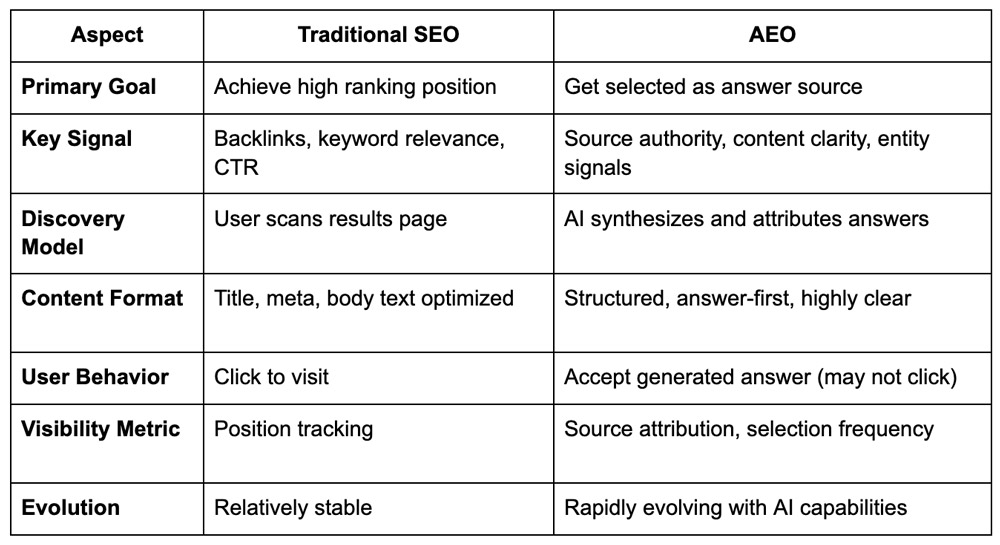
The practical take: SEO creates the foundation. AEO optimizes that foundation for AI discovery. You need both.
How AI Search Engines Choose Your Content
Understanding this is crucial. AI systems select content sources based on a different decision tree than traditional ranking algorithms.
1. Authority and Trust Signals
AI systems prioritize sources that are already recognized as authoritative. This includes:
- Domain authority and topical authority
- Author credentials and expertise
- Third-party validation (awards, certifications, mentions)
- Entity signals (Is this a recognized brand/person?)
- Historical accuracy (Does this source get fact-checked and corrected?)
What this means for you: Building topical authority and entity recognition is now more important than ever. A single high-ranking page doesn’t guarantee AI selection. A whole cluster of expert content does.
2. Content Structure and Clarity
AI systems need to understand your content quickly and extract answers easily. This means:
- Clear heading structure (H1 → H2 → H3)
- Direct answers placed early (within first 150 words)
- Concise explanations without fluff
- Structured data markup (schema, JSON-LD)
- Logical content flow
What this means for you: Your writing needs to be brutally clear. No room for rambling intros or buried answers.
3. Relevance to User Intent
AI systems are getting better at understanding what users actually want to know. If your content solves the exact problem the user is asking about, you’re more likely to be selected – even if you’re not ranking #1 traditionally.
What this means for you: Deep intent analysis beats generic keyword targeting.
4. Freshness and Factual Accuracy
AI systems are programmed to be cautious about misinformation. Content that’s current, well-sourced, and factually accurate is selected more reliably.
What this means for you: One-time content creation isn’t enough. Updating for accuracy and current information matters.
The Graphicwise AEO Visibility Framework
Based on what we’re seeing across client work and industry shifts, here’s how to approach AEO strategically:
Step 1: Structure Your Content Clearly
Don’t assume AI systems will figure out what you mean. Make it obvious.
- Lead with direct answers
- Use clear heading hierarchies
- Break complex topics into digestible sections
- Use bullet points and numbered lists
- Include practical examples
Step 2: Build Topical Authority
AI systems reward brands that own a topic. You’re not trying to rank for 100 different keywords. You’re trying to become the recognized authority on a specific topic cluster.
Example: Instead of one article on “AEO basics,” build a topical cluster:
- What Is AEO?
- AEO vs. SEO
- How to Optimize for ChatGPT
- Best AEO Tools
- Entity SEO Guide
- Answer Engine Marketing Strategy
Each piece strengthens the others. Together, they signal topical authority to AI systems.
Step 3: Strengthen Entity Signals
AI systems understand the world through entities – people, brands, organizations, locations, concepts. The more clearly you establish entity signals around your brand or topic, the more reliably AI systems will recognize and select you.
This means:
- Clear brand/author identification (Who are you? What are your credentials?)
- Knowledge panel optimization (Wikipedia, Google, industry directories)
- Consistent naming and descriptions (Use the same terminology everywhere)
- Relationship signals (How do you connect to other recognized entities?)
Step 4: Improve Trust Signals
AI systems are trained to be conservative about trust. They look for:
- Author credentials and expertise
- Citations and sources
- Transparency about methods
- Consistency over time
- No signs of manipulation (keyword stuffing, purchased links, etc.)
Step 5: Create Answer-First Content
AEO content answers the question immediately, then provides supporting detail. This is the opposite of traditional article structure where you might build narrative suspense.
Example structure:
- Direct answer (1-2 sentences)
- Why this matters (context)
- Detailed explanation with examples
- Practical implementation
- Common mistakes to avoid
- FAQ for related questions
Practical Steps: How to Start with AEO
For Existing Content
Audit for clarity:
- Does your answer appear in the first 100 words?
- Can someone understand your answer without reading the whole article?
- Are your headings descriptive and hierarchical?
Add structure:
- Include schema markup (FAQPage, HowTo, Article types)
- Create a summary box at the top
- Add a table of contents
- Use structured data for key facts
Strengthen authority signals:
- Add author bio with credentials
- Include publication date and last updated date
- Link to other related content (internal linking)
- Cite reputable sources
For New Content
Start with AEO principles from the beginning:
- Understand exact user intent (What specific question are they asking?)
- Answer directly (First paragraph should contain the answer)
- Structure clearly (Obvious headings, bullets, examples)
- Add context (Why does this matter? When would you use this?)
- Provide implementation guidance (What should the reader do?)
- Acknowledge limitations (When does this approach not work?)
Tools and Setup
You don’t need specialized “AEO tools” yet (the category is still developing). Instead:
- Use search generative experience tools (Test how your content appears in Google’s AI Overviews)
- Monitor AI search selection (Use ChatGPT’s search feature to see if your content gets selected)
- Analyze competitor answers (What sources do AI systems choose for your target topics?)
- Track source attribution (Monitor where your brand appears in AI-generated answers)
- Standard SEO tools (Ahrefs, Semrush, Moz – still valuable for topical authority and backlinks)
Common AEO Mistakes (And How to Avoid Them)
Mistake 1: Assuming AEO Replaces SEO
What happens: Brands stop worrying about ranking position and backlinks.
Why it fails: AI systems still rely on traditional authority signals. If you’re not building domain authority, you won’t be selected by AI.
Fix: Do both. Think of AEO as optimizing top-of-funnel SEO.
Mistake 2: Creating “AEO Content” Separate from Regular Content
What happens: Teams create specialized, minimal answer articles alongside regular content.
Why it fails: Inconsistency confuses AI systems. They expect a cohesive topical approach.
Fix: Apply AEO principles to all content. Make answers clear. Structure logically. Build authority across everything.
Mistake 3: Keyword Stuffing for AI (Yes, This Is Happening)
What happens: Brands load articles with keyword variations hoping AI will select them.
Why it fails: AI systems are designed to recognize and penalize this. It makes content worse, not better.
Fix: Write for humans. Use semantic variations naturally. Let clarity guide keyword placement.
Mistake 4: Ignoring Freshness
What happens: Content ranks well, so teams assume it’s “done”.
Why it fails: AI systems especially penalize outdated information. They’re trained to recognize current events, new research, and changing landscapes.
Fix: Update content regularly. Especially important for breaking industry news or statistical data.
Mistake 5: Not Building Topical Authority
What happens: Random, disconnected content across the website.
Why it fails: AI systems reward topical clusters, not individual posts. Without topical authority, you’re competing as a generalist.
Fix: Identify 3-5 core topics. Build comprehensive content clusters around each. Link them together logically.
AEO Checklist: Getting Started
Use this checklist to audit your content readiness for AEO:
Content Structure
- ☐ Answer is in the first 100 words
- ☐ Heading hierarchy is clear (H1 → H2 → H3)
- ☐ Paragraphs are short (2-3 sentences max)
- ☐ Key points are bulleted or numbered
- ☐ Examples are concrete and relevant
Authority & Trust
- ☐ Author credentials are clear
- ☐ Publication date is visible
- ☐ Content is regularly updated
- ☐ Sources are cited
- ☐ Brand/entity signals are consistent
Technical & Markup
- ☐ Schema markup is implemented
- ☐ Internal linking is natural and relevant
- ☐ Mobile experience is optimized
- ☐ Page speed is acceptable (under 3 seconds)
- ☐ Images have descriptive alt text
Topical Authority
- ☐ Content clusters exist around core topics
- ☐ Related content is linked internally
- ☐ Topic depth increases across pieces
- ☐ Entity relationships are clear
Looking Ahead: AEO in 2026 and Beyond
The search landscape has always evolved. From directories to Google to voice search to mobile-first indexing – each shift required adaptation.
AEO is the next evolution. It’s not a fad. It’s a fundamental shift in how AI systems discover, evaluate, and present information.
Brands that adapt early – that invest in clear content, topical authority, and strong entity signals – are positioning themselves for continued visibility as AI search becomes more prevalent. Those that wait and hope traditional rankings are enough will find themselves increasingly invisible to AI-driven discovery.
The good news: Getting started doesn’t require a complete overhaul. It requires a strategic shift in how you think about clarity, authority, and structure. Those are all good practices anyway.
As AI search continues to evolve, brands that build authentic expertise and communicate it clearly will have a sustainable advantage. That’s always been true. AEO just makes the mechanics more transparent.
Ready to build your AEO strategy? Start with your highest-value topics, apply the framework and checklist above, and monitor how your content appears in AI-generated answers. Small, consistent improvements compound over time.
FAQ
Q: Do I need to optimize for ChatGPT specifically?
A: ChatGPT’s search feature selects sources differently than Google’s AI Overviews. Right now, the best approach is to apply general AEO principles – clarity, authority, structure – that work across systems. Specialized ChatGPT optimization may matter more in 2027-2028.
Q: Will AEO change how I do keyword research?
A: Keyword research is still valuable, but intent analysis matters more. You’re looking for the actual questions users ask, not just search volume and competition. Tools like Answer the Public and community forums reveal this better than traditional keyword metrics.
Q: Can I rank well on Google but not appear in AI answers?
A: Yes. It’s possible to rank #1 but not be selected as an AI source. This usually means your content, while optimized for traditional SEO, isn’t clear enough or doesn’t have sufficient authority signals for AI selection.
Q: Is AEO hurting my traffic?
A: Not necessarily. Early research suggests that appearing in AI-generated answers still drives traffic – just through a different mechanism. Users see your answer is cited and often visit for full context.
Q: What’s the timeline for AEO to matter?
A: It’s already mattering now. AI search adoption is accelerating. The question isn’t whether to start, but how quickly you adapt.
See more: Comprehensive Strategies for Improving Search Rankings
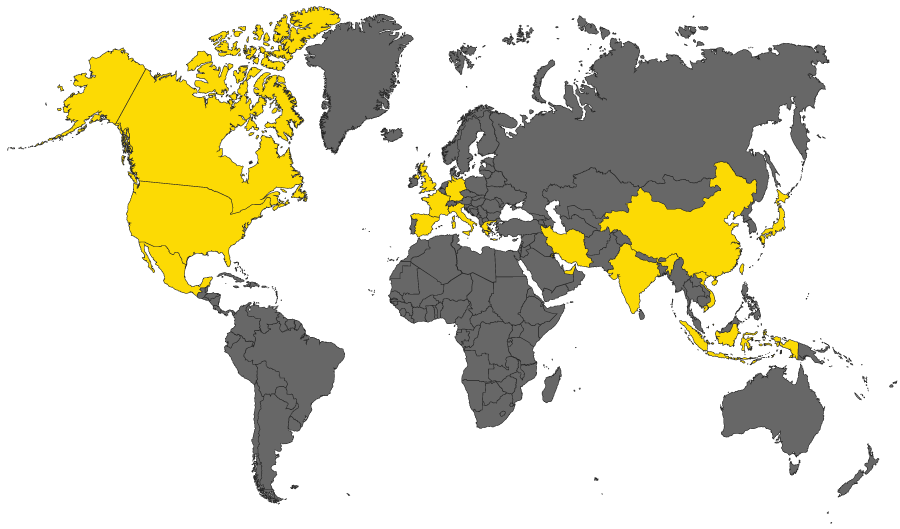
Serving clients across the globe.