Why Your Website Isn’t Ranking in Google (and How to Fix It in 2026)
You built a nice website, but it still does not show up on Google. Sound familiar? If your website isn’t ranking on Google, you are not alone. The good news is that this is almost always fixable.
This guide explains why this happens and how to fix it in 2026. Most ranking problems come from a handful of common issues, not bad luck. We keep things simple, with clear digital marketing steps you can use today. Let us look at what is holding your website back, and how to turn it around.

The Most Common Reasons A Website Does Not Rank
When a website does not rank, the cause usually falls into a few buckets. Here are the issues we see most often.
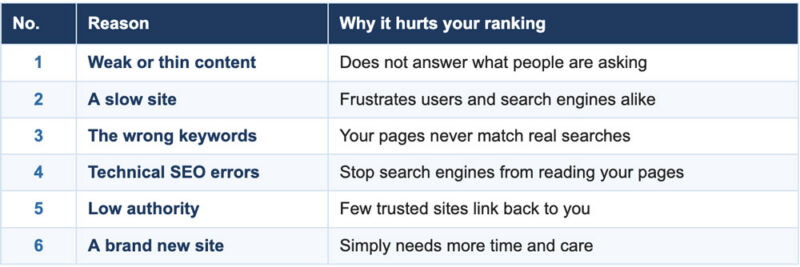
Most websites have more than one of these problems at once, which is why visibility suffers. The fix is to work through them one by one. Let us start with the biggest factor in 2026: your content.
Your Content Isn’t Built For How Google Ranks in 2026
Content is still the heart of SEO. In 2026, Google rewards content that is helpful, clear, and written for real people. If your pages are thin, generic, or stuffed with keywords, you won’t rank well.
Google now reads your content the way a smart reader would. It wants to see real experience, useful detail, and answers to the questions people actually ask. Content that copies what everyone else says does not stand out, so it stays buried.
To improve this, build content with real value. Write for the user first, then for search engines. Good content puts the user ahead of any trick. Cover each topic in full, answer common questions, and show that you know your field. This is also what helps you show up in AI search tools, which now pull answers straight from helpful content.
Strong content gives you something worth ranking for, and a real shot at higher rankings. But content alone is not enough if your site is slow.
Your Website is Too Slow
Speed matters more than ever. A slow website hurts both your rankings and your user experience. If a page takes too long to load, visitors leave, and search engines notice.
Google uses site speed and overall performance as ranking signals. A fast website keeps users happy and tells search engines that your pages are worth showing. A slow one quietly drags your rankings down.
Common slowdowns include huge images, heavy code, and cheap hosting. Test it on a phone, since most people use mobile. Then improve the slowest pages first.
When your website loads fast and feels smooth, users stay longer and Google rewards that. This is one of the quicker wins to make, and the results show up fast.
You Are Targeting The Wrong Keywords
You can have great content, but if you target the wrong search terms, your website still will not rank for the terms that matter. Many businesses guess at these terms instead of researching them.
Good keyword research shows you what your customers actually type into the search bar. It also shows how hard each term is to rank for. Picking terms that are too broad or too competitive is a common reason pages get no traffic.
The fix is simple. Focus on clear, specific phrases that match what you offer and what buyers search for. Use them naturally in your titles, headings, and content. Tailor each page to one main search idea.
When your terms match real demand, your content finally has a path to the top of Google.
Your Site Has Technical SEO Issues
Sometimes your content is great, but technical SEO issues block your ranking. If search engines cannot read or index your content properly, your pages will not show up at all.
Common technical errors include broken links, missing page titles, no clear structure, and content that crawlers cannot reach. Structured SEO helps Google understand your content and rank it correctly. Schema markup, clean web addresses, and a simple menu all make a real difference.
These problems are easy to miss, because everything looks fine to you. An SEO audit finds the hidden problems that quietly hold your rankings back.
Once the technical base is solid, every other change you make works harder. A clean foundation is the key to lasting SEO wins.
Your Website Doesn’t Show Enough Authority
Google ranks websites it trusts. If your business is new or unknown, it may lack the authority to rank for competitive terms. This standing is built over time, and it is one reason patience matters in 2026.
The biggest signal of authority is backlinks, which are links from other trusted sites to yours. A few strong, relevant backlinks tell Google that your business is real and respected. So does clear information about who you are and why people should trust you.
To build your reputation, earn links from local groups, partners, and industry blogs. Show your team, your experience, and real proof of your work. This is the heart of trust, and Google looks for it closely.
That reputation turns a good website into one that ranks and stays there.
How To Fix Your Ranking Issues in 2026
Sorting all of this out in 2026 is about steady, smart work, not magic. Work through this checklist in order, and tick off each step as you go.
| Your 2026 ranking checklist
☐ Run a full SEO audit to find your biggest weak spots. ☐ Fix the technical errors that block crawling and indexing. ☐ Improve your thin pages so they answer real questions. ☐ Target specific, realistic keywords for each topic. ☐ Speed up your load times for a better user experience. ☐ Build authority with quality backlinks over time. |
Give it time and track your results each month. Small, steady steps add up to real movement in your Google rankings.
Final Thoughts: Real SEO Results Take A Strategy
Strong rankings do not come from one quick trick. They come from a clear strategy that fixes each issue and keeps your website healthy as Google changes. The businesses that win in 2026 treat SEO as ongoing growth, not a one time task.
After more than two decades of working with businesses, we’ve learned that lasting Google rankings do not come from quick SEO tricks or one time fixes. They come from building a trusted brand, creating a high quality website, sharing content that truly helps people, and following a clear long term strategy. That is the approach Graphicwise has used to help businesses grow for over 20 years.
Better rankings begin with a stronger foundation, and every improvement you make today helps build long term success.
Frequently Asked Questions
Why isn’t my website showing up on Google?
Most likely your website has thin content, slow load times, the wrong terms, or technical SEO errors. Often it is a mix of these. An SEO audit shows you the exact reasons and what to fix first.
How long does it take to see results?
Most websites see real movement in three to six months of steady work. SEO rewards consistency, so the businesses that keep improving tend to win.
Can I improve my own rankings?
Yes, you can improve many things yourself, like load times and content. For deeper technical SEO and authority, an experienced team often gets results faster.
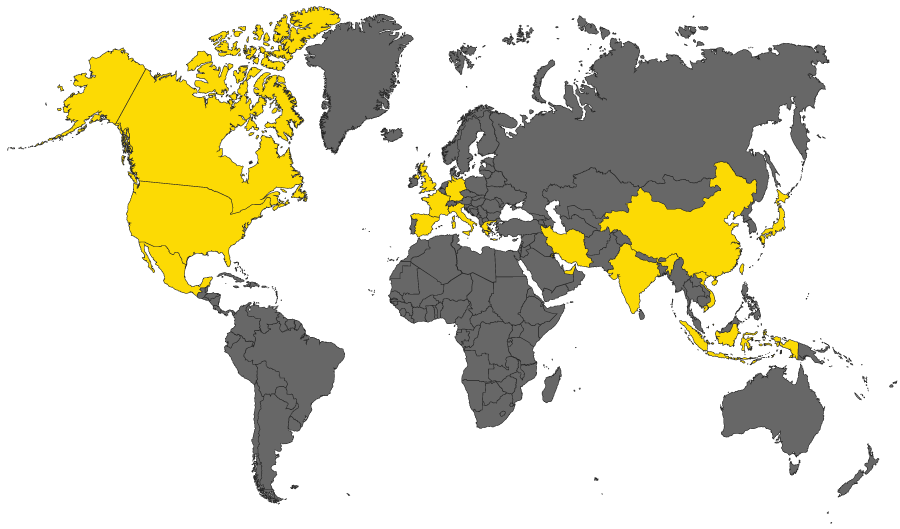
Serving clients across the globe.