How to Build Topical Authority for AI Search in 2026
Learning how to build topical authority for AI search starts with creating useful, connected content around your business’s expertise. Instead of targeting individual keywords, you need a strategy that covers important topics and answers your audience’s questions.
At Graphicwise, we help businesses strengthen their online presence through SEO, content strategy, and digital marketing. Here are seven steps to build topical authority for traditional and AI search.
What is topical authority in AI search?
Topical authority refers to how well a website demonstrates expertise in a specific subject through accurate, relevant, and connected content.
For example, a marketing agency that publishes useful articles about SEO, Answer Engine Optimization (AEO), and Generative Engine Optimization (GEO) can demonstrate broader expertise than one publishing unrelated marketing topics.
Building topical authority involves four elements:
- Topic coverage: Answering important questions within your area of expertise.
- Topic clusters: Organizing related articles around a central subject.
- Internal linking: Connecting pages to show relationships between topics.
- Credible content: Providing accurate information supported by experience and reliable sources.
Topical authority is not an official Google ranking metric. It is a content strategy that supports relevance, expertise, and search visibility.
Why topical authority matters for SEO and AI search
Topical authority helps search engines understand your website’s expertise while creating more opportunities to reach people searching for related information.
Helps search engines understand your expertise
When your website covers related topics in depth, search engines have more context to understand your content.
For example, articles about keyword research, technical SEO, and content strategy provide broader coverage of SEO than a single general article.
Connects related topics and search intent
Topic clusters connect broad subjects with specific questions.
Someone researching AI search might first want to understand AEO before exploring optimization strategies. Connecting these articles helps readers find relevant information.
Creates more opportunities for AI search visibility
AI search tools such as ChatGPT Search, Google AI Overviews, and Perplexity can reference web content when generating answers.
Websites covering different aspects of a subject may have more relevant pages available for different questions.
Generative Engine Optimization (GEO) focuses on improving how businesses and their content are discovered, understood, and represented in AI search results.
However, topical authority does not guarantee AI citations. Relevance, accessibility, and source selection also matter.
How to build topical authority for AI search in 7 steps
Building topical authority requires a clear plan that connects your expertise with your audience’s information needs.
Step 1. Define your core topic and expertise
Start by choosing the main subject your business wants to be known for.
Your core topic should reflect your services, experience, and customers’ needs.
For example, a digital marketing agency might focus on SEO, content marketing, or AI search optimization.
Ask yourself:
- What services does our business specialize in?
- What problems do our customers need help solving?
- Which topics can we explain through real experience?
Choose one clear area of focus before expanding into related subjects.
Step 2. Research search intent and related topics
Identify what your audience wants to know about your core topic.
Use Google Search, keyword research tools, and Google Search Console to find relevant questions.
Group them by search intent:
- Informational: Users want explanations or instructions.
- Commercial: Users want to compare options.
- Transactional: Users are ready to take action.
For example, “what is AEO” reflects informational intent, while “AEO services for businesses” reflects commercial intent.
Understanding search intent helps you create articles that answer different questions without unnecessary overlap.
Step 3. Create a topical map
A topical map organizes your main subject into smaller, related topics. It helps identify existing content, missing subjects, and opportunities for new articles.
For example, if AI Search Optimization is your core topic, you could organize your content into these clusters:
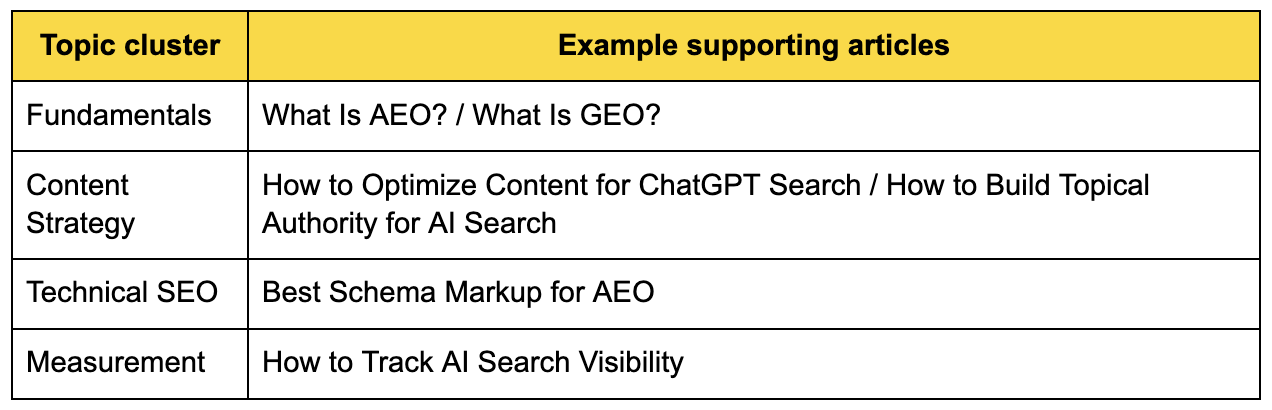
To create your topical map, list existing articles, group them by subject, and identify important content gaps.
Each article should address a distinct search intent rather than repeat information covered elsewhere.
Step 4. Build pillar pages and supporting topic clusters
Once your topical map is ready, organize your content into pillar pages and supporting articles.
A pillar page provides an overview of a broad subject, while supporting articles explore specific topics in greater detail.
For example, an AI search optimization pillar page could connect to articles about AEO, GEO, technical requirements, and performance measurement.
This structure helps readers explore related information and gives search engines clearer paths to discover your content.
Step 5. Strengthen internal linking
Internal links connect related pages and help readers navigate your website.
To improve internal linking:
- Connect related articles: Link pages that provide useful context.
- Use descriptive anchor text: Make the destination topic clear.
- Link to pillar pages: Connect supporting articles to broader subjects.
- Review existing links: Fix broken links and add relevant connections.
For example, content about AI search strategy can reference Answer Engine Optimization (AEO) when explaining how businesses can improve their visibility in answer-based search.
Each internal link should provide value rather than simply increase the number of links.
Step 6. Add original insights and credible information
Publishing more articles does not automatically establish topical authority. Content quality and credibility are equally important.
Strengthen your content by:
- Sharing original insights: Include examples, research, or practical experience.
- Using reliable sources: Support important claims with trustworthy information.
- Demonstrating expertise: Explain how concepts apply in real situations.
- Updating information: Review content when industry practices change.
Relevant backlinks and brand mentions from reputable websites can also support SEO and brand credibility.
Step 7. Monitor and expand your topic coverage
Building topical authority is an ongoing process.
Use Google Search Console to review impressions, clicks, and search queries across related articles.
Focus on:
- Topics attracting relevant organic traffic.
- Important questions your content has not answered.
- Pages that need updated information.
- Opportunities to improve internal linking.
You can also track whether your content appears in relevant AI search answers, although results may vary between platforms.
Use these findings to update your topical map and plan future articles.
Common mistakes that weaken topical authority
Avoid these mistakes when developing your content strategy:
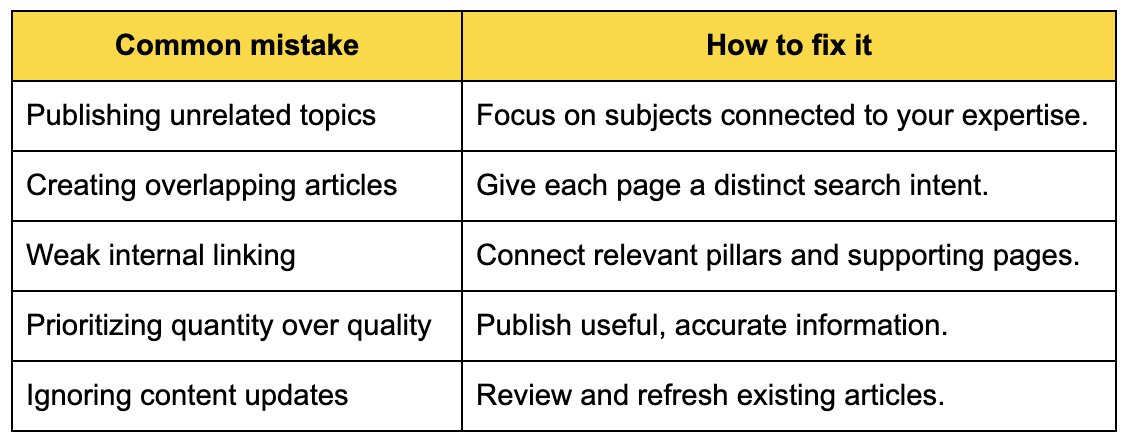
A focused content strategy helps your website provide consistent value without creating unnecessary articles.
Topical authority checklist for AI search
Use this checklist to review your content strategy:
- Core topic: Is your main area of expertise clearly defined?
- Topic coverage: Have you addressed important related questions?
- Content structure: Are pillar pages and supporting articles organized?
- Internal linking: Are related pages connected?
- Content credibility: Does your content provide accurate, original value?
- Content updates: Do you regularly review and improve existing pages?
If you identify gaps, update your topical map before creating additional content.
Build a stronger content strategy with Graphicwise
Building topical authority for AI search requires a clear content plan, connected articles, and credible information.
At Graphicwise, we combine SEO, content strategy, and digital marketing to help businesses strengthen their online visibility.
If you want to develop a more focused content strategy and improve your website’s topical authority, contact us to discuss your goals.
Frequently asked questions about topical authority
How long does it take to build topical authority?
Building topical authority can take several months or longer. Results depend on competition, content quality, website history, and publishing consistency.
How many articles do you need to build topical authority?
There is no fixed number. Focus on covering important topics, answering different search intents, and connecting related articles.
Can a small website build topical authority?
Yes. Small websites can build topical authority by focusing on a specific subject and gradually expanding into related topics.
Can AI generated content build topical authority?
AI can assist with research and drafting, but content still needs accuracy, human review, and original value to demonstrate expertise.
Does topical authority guarantee AI search visibility?
No. Topical authority supports SEO and AI search strategies, but visibility also depends on relevance, accessibility, and source selection.
Serving clients across the globe.